Ho presentato all’ATS (American Thoracic Society – International Conference) di San Diego il lavoro “Small Airways Disease (SAD) in Severe Asthma as a Novel Endpoint and Distinct Target for Mepolizumab (SASAM Study)”, nell’ambito della sessione dedicata alle terapie biologiche nell’asma e nell’infiammazione allergica.
Lo studio SASAM nasce con l’obiettivo di approfondire il ruolo delle piccole vie aeree nell’asma grave e di valutare come queste possano rappresentare un importante parametro clinico nel monitoraggio della risposta alla terapia biologica con mepolizumab.
Le piccole vie aeree costituiscono la parte più periferica dell’albero bronchiale e il loro coinvolgimento può contribuire in maniera significativa alla persistenza dei sintomi e al controllo non ottimale dell’asma.
Lo studio ha quindi analizzato l’effetto del trattamento con mepolizumab sulla Small Airways Disease (SAD), utilizzando strumenti di valutazione funzionale come l’oscillometria a impulsi e la spirometria.


Location
San Diego Convention Center, Area F (Hall A-B2, Ground Level)
Description
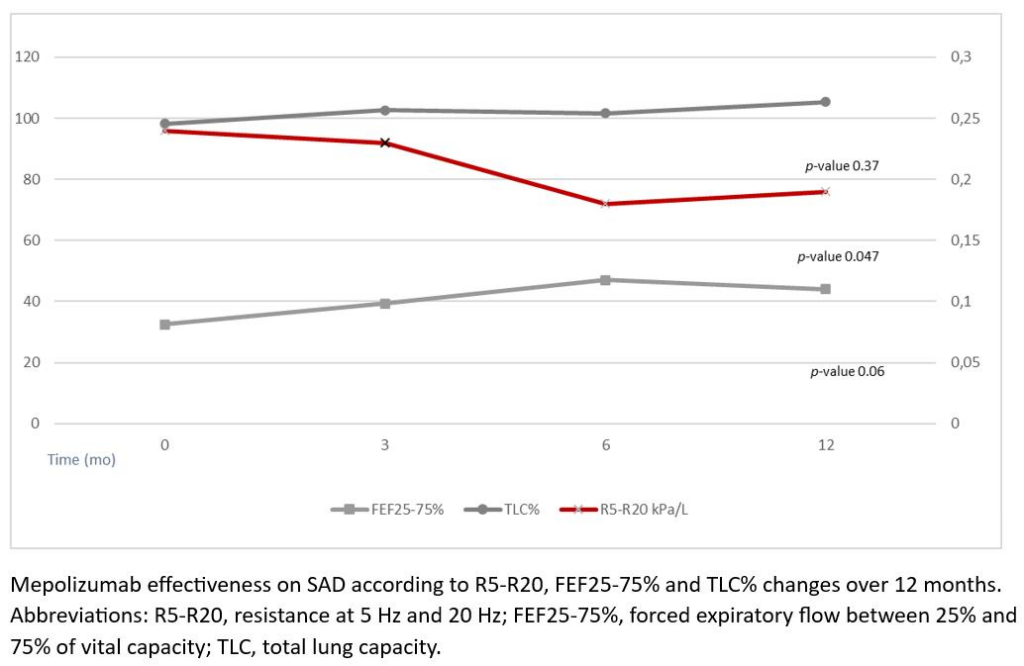
Introduction: Mepolizumab represents an effective and safe strategy for severe eosinophilic asthma (SEA) treatment which improves lung function, controls inflammation and reduces exacerbations with a steroid-sparing effect. Very limited findings are available about the effect of mepolizumab on Small Airways (SA), which are significantly affected in SEA and associated with worse disease outcomes . Objectives: We hypothesize that mepolizumab has a significant beneficial effect on Small Airways Diseases (SAD) in severe asthmatics and that the evaluation of SA through impulse oscillometry (IOS) before and during treatment could represent a distinctive marker of response and a novel target of treatment. We had previously presented preliminary promising data showing mepolizumab effect on SAD at 6 months. Methods: We prospectively analysed 13 subjects with (SEA) treated with mepolizumab 100 mcg s.c. SAD direct and indirect measurements, assessed by IOS (R5-R20) and spirometry (FEF25-75%, TLC% predicted) respectively, were collected at baseline and at 1-year of treatment. Change in SA measurements were related to other functional (FEV1% predicted, FEV1/FVC) clinical (ACT score, rates of asthma exacerbations/previous year, OCS use) and inflammatory parameters (blood eosinophil count, FeNO and total serum IgE). Results: Data analysis over 1 year-treatment documented a R5-R20 decreased mean value from 0.24 (±0.14) to 0.19 (±0.15) kPa/L at T12 (p=0.047). FEF25-75% pred. progressively increased from 32.5 (±22.3) to 44.0 (±31.5) at T12 (p=0.06), as well as TLC% pred. from 98.2 (±18.3) to 105.3 (±9.3) at T12 (p=0.37) . It was observed an improvement of mean FEV1% from 73.1 (±25.2) to 82.9 (±27,9) (p=0.038) and of FEV1/FVC from 0.60 (±0.16) to 0.67 (±0.15; p=0.03). ACT score improved at T12 (from 15.1 ±5.4 to 20.8 ±3.9; p=0.002). All the subjects with OCS dependent asthma discontinued OCS treatment after 3 months of mepolizumab and the number of subjects experiencing at least 1 exacerbation in 1 year decreased from 77% to 30% (p=0.018). Blood eosinophilic count and FeNO value significantly decreased, from 369.5 (±230.2) to 59.8 (±41.3) cells/mcL p=0.0006) and from 48.2 (±44.0) to 40.8 (±27.0) ppb (p=0.06), respectively. Total serum IgE did not significantly change over the treatment period. Conclusions: Mepolizumab improved all evaluated outcomes including SAD, suggesting its possible role as treatment targeting SA. R5-R20, compared to the other indirect parameters of SAD, was found to be the most reliable measurement to detect mepolizumab beneficial effect on SA involvement.
.
Torna alla Pagina Principale.